Data as of November 22, 2026. The lithium price recovered strongly in 2026 after two years of decline. According to the Chilean Copper Commission's report presented on November 12 (Cochilco, November 12, 2026 report, via Reporte Minero), lithium carbonate reached US$18,950 a ton on September 24, up 102.7% from January 2025, and the agency forecasts an average of US$19,000 for the fourth quarter and US$18,500 for 2027. At the official dollar rate of CLP 1,008.79 (Central Bank, November 20), a ton at that forecast price is worth about CLP 19,167,010. But the peak is already behind: SQM reported that its realized price fell 10% between the second and third quarters, and expects another drop (SQM's results through September, via Minería Chilena).
View the data as a table
| Price on September 24 (US$/t) | US$18,950 |
| Rise since January 2025 | 102.7% |
| Q4 2026 forecast (US$/t) | US$19,000 |
| SQM realized price, Q3 (US$/kg) | US$19.6 |
Lithium price today: what a ton is worth in dollars and pesos
Lithium does not trade on a single exchange the way copper does in London. The most used benchmarks are lithium carbonate (the product Chile exports most), lithium hydroxide and spodumene, the mineral from Australia's hard-rock mines. Each has different contract and spot prices, which is why figures from different sources do not always match. Cochilco uses a FOB South America benchmark; the US Geological Survey (USGS) publishes the annual average of contract prices for battery-grade carbonate; and SQM reports its average realized price, what it actually charged per ton sold in the quarter.
| Benchmark | US$ per ton | In pesos per ton | In pesos per kilo | Source and date |
|---|---|---|---|---|
| Carbonate, FOB South America | US$18,950 | CLP 19,116,571 | CLP 19,117 | Cochilco, Sep 24, 2026 |
| Q4 2026 forecast | US$19,000 | CLP 19,167,010 | CLP 19,167 | Cochilco, Nov 12, 2026 |
| SQM realized price, Q3 | US$19,600 | CLP 19,772,284 | CLP 19,772 | SQM, Nov 18, 2026 |
| 2027 forecast | US$18,500 | CLP 18,662,615 | CLP 18,663 | Cochilco, Nov 12, 2026 |
Conversion to pesos at the official dollar rate of November 20, 2026 (CLP 1,008.79, Central Bank); Pauta Financiera calculation. SQM's realized price is reported in US$ per kilo (US$19.6/kg = US$19,600/t).
The lithium price from 2015 to 2026: boom, bust and recovery
The USGS series shows a market of extremes. In 2015 battery-grade carbonate averaged US$6,500 a ton in contracts; in 2022, with the electric-car rush and tight supply, it jumped to US$68,100 in nominal terms, more than ten times as much (USGS, 2020 to 2024 editions). It has since collapsed: the 2024 average was US$11,800 and the 2025 average US$9,000, 31% lower, both in 2025 dollars (USGS, Mineral Commodity Summaries 2026). The same report records that the spot price in China went from about US$9,300 in January 2025 to about US$10,300 in November, the start of the recovery that in 2026 took prices to around US$19,000.
View the data as a table
| Nominal (USGS 2020-2024) | Real, 2025 US$ (USGS 2026) | |
|---|---|---|
| 2015 | US$6,500 | No data |
| 2016 | US$8,650 | No data |
| 2017 | US$15,000 | No data |
| 2018 | US$16,000 | No data |
| 2019 | US$12,100 | No data |
| 2020 | US$8,600 | No data |
| 2021 | US$12,600 | US$11,700 |
| 2022 | US$68,100 | US$63,700 |
| 2023 | US$46,000 | US$39,000 |
| 2024 | No data | US$11,800 |
| 2025 | No data | US$9,000 |
| Year | Nominal price (US$/t) | Real price, 2025 US$ | USGS edition |
|---|---|---|---|
| 2015 | US$6,500 | — | MCS 2020 |
| 2016 | US$8,650 | — | MCS 2021 |
| 2017 | US$15,000 | — | MCS 2022 |
| 2018 | US$16,000 | — | MCS 2023 |
| 2019 | US$12,100 | — | MCS 2024 |
| 2020 | US$8,600 | — | MCS 2024 |
| 2021 | US$12,600 | US$11,700 | MCS 2024 / MCS 2026 |
| 2022 | US$68,100 | US$63,700 | MCS 2024 / MCS 2026 |
| 2023 | US$46,000 | US$39,000 | MCS 2024 / MCS 2026 |
| 2024 | — | US$11,800 | MCS 2026 |
| 2025 | — | US$9,000 | MCS 2026 |
Carbonate, hydroxide and spodumene: lithium's three prices
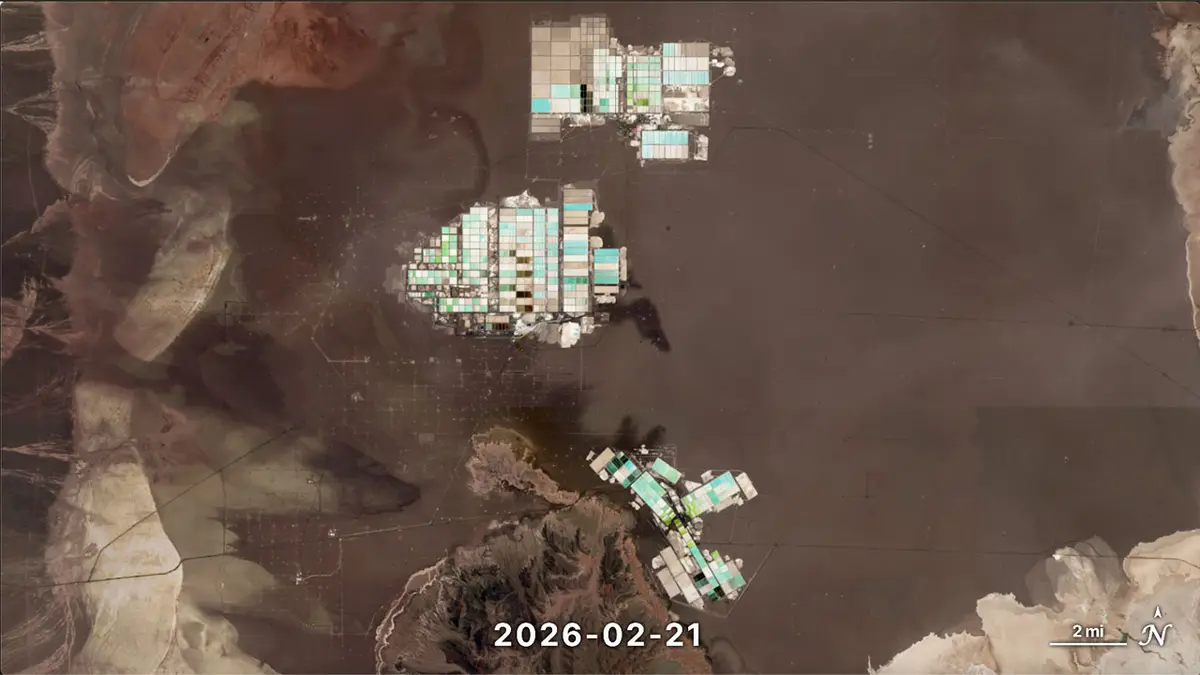
When people talk about the lithium price, it helps to know which product they mean. Chile produces lithium from brines: salty groundwater from beneath the Salar de Atacama is pumped into ponds where the sun evaporates the water and concentrates the salts, which are then processed in chemical plants into lithium carbonate and, to a lesser extent, hydroxide. Australia, by contrast, digs spodumene from hard-rock mines and sells it as a concentrate, generally to Chinese refiners. According to the USGS, in 2025 the world had two brine operations in Chile, four in Argentina and six in China, versus seven hard-rock operations in Australia and nine in China (USGS, Mineral Commodity Summaries 2026). All three products rose in the second half of 2025:
| Product | January 2025 (US$/t) | November 2025 (US$/t) | Change |
|---|---|---|---|
| Lithium carbonate, China spot (CIF) | US$9,300 | US$10,300 | +10.8% |
| Lithium hydroxide, China spot (FOB) | US$10,300 | US$11,200 | +8.7% |
| Spodumene 6%, Australia (FOB) | US$800 | US$970 | +21.2% |
Source: USGS, Mineral Commodity Summaries 2026, approximate values reported by the agency; change calculated by Pauta Financiera. Chile is also the main lithium supplier to the United States: 54% of its imports between 2021 and 2024, versus 43% from Argentina.
What moves the lithium price
Lithium depends on a single industry more than almost any other raw material. According to the USGS, 88% of world use went to batteries in 2025, and global consumption rose 20%, to 263,000 tons of lithium content (USGS, Mineral Commodity Summaries 2026). These are the factors that weigh most:
- Electric cars. Cochilco estimates that EV batteries will account for 57.5% of 2026 demand (Cochilco, November 12, 2026 report, via Reporte Minero).
- Energy storage. Grid batteries (BESS) would already be 32% of 2026 demand, the fastest-growing segment.
- Supply. World output rose 31% in 2025 to about 290,000 tons, with new operations in Argentina, Brazil, Canada, Mali and Zimbabwe (USGS, Mineral Commodity Summaries 2026).
- The balance. Cochilco estimates a deficit of 79 thousand tons of carbonate equivalent in 2026, turning into a surplus of 42 thousand in 2027: hence its slightly lower price forecast for next year.
SQM and the lithium price in 2026, quarter by quarter
The finest data point for the Chilean market comes from SQM, which operates in the Salar de Atacama with Codelco through Novandino. Its average realized price was US$17.8 a kilo in the first quarter (Reporte Minero), rose to US$21.8 in the second (Minería Chilena) and fell to US$19.6 in the third, although it is still 123% above a year earlier (SQM's results through September, via Minería Chilena). At those prices, the company earned US$1,569 million through September, up 288%. We cover the results in detail in SQM's profit and its shares.
Who produces the most lithium in the world
Australia leads mine production with an estimated 92,000 tons of lithium content in 2025, followed by China (62,000) and Chile (56,000), according to USGS, Mineral Commodity Summaries 2026. Chile supplies about 19% of world output but holds the largest reserves: 9.2 million tons, about 25% of the total. Cochilco, with a different metric (carbonate equivalent and total supply), estimates that Chile's share fell from 30% in 2024 to 19% in 2025 and 17% in 2026, because other countries are growing faster (Cochilco, November 12, 2026 report, via Reporte Minero).
View the data as a table
| Reserves (t) | |
|---|---|
| Chile | 9,200,000 |
| Australia | 8,400,000 |
| China | 4,600,000 |
| Argentina | 4,400,000 |
| United States | 4,400,000 |
| Canada | 1,600,000 |
| Brazil | 540,000 |
| Zimbabwe | 500,000 |
| Mali | 370,000 |
| Portugal | 60,000 |
| Country | Output 2024 (t) | Output 2025e (t) | Reserves (t) |
|---|---|---|---|
| Australia | 82,700 | 92,000 | 8,400,000 |
| China | 41,400 | 62,000 | 4,600,000 |
| Chile | 48,900 | 56,000 | 9,200,000 |
| Zimbabwe | 20,000 | 28,000 | 500,000 |
| Argentina | 13,800 | 23,000 | 4,400,000 |
| Brazil | 10,200 | 12,000 | 540,000 |
| Mali | 770 | 9,400 | 370,000 |
| Canada | 4,820 | 5,600 | 1,600,000 |
| Portugal | 380 | 380 | 60,000 |
| United States | not published | not published | 4,400,000 |
| World total | 222,000 | 290,000 | 37,000,000 |
Source: USGS, Mineral Commodity Summaries 2026. Tons of lithium content (not carbonate). World totals exclude the United States and are rounded.
What the lithium price means for Chile
For Chile, lithium is the second most important metal after copper. Cochilco estimates that the country produced 311.3 thousand tons of carbonate equivalent in 2025 and will reach 325 thousand in 2026 and 335 thousand in 2027 (Cochilco, November 12, 2026 report, via Reporte Minero). A higher price means more dollars coming into the country, more taxes and more payments to Corfo under the Salar de Atacama contracts, and it partly offsets the fall in copper. Copper is also having its worst run of the year, as we report in the copper price today, and both metals weigh on the exchange rate we explain in the dollar today in Chile.
How to invest in lithium from Chile
No instrument directly tracking the lithium price is available to a Chilean retail investor. The usual alternatives are indirect: shares of producers listed on the Santiago Stock Exchange, such as SQM, whose price depends on lithium but also on its costs, contracts and mining policy; or foreign exchange-traded funds (ETFs) of companies in the sector, which combine miners and battery makers. We explain the steps and costs in how to invest on the Santiago Stock Exchange and in what an ETF is and how to buy one from Chile. Both routes are high risk: the lithium price rose tenfold and then lost almost 90% in three years.
This information is journalistic and educational, not investment advice.
Does your mining company, fund or brokerage want to reach people who follow lithium and the markets? See Pauta Financiera's formats.
See advertising optionsFrequently asked questions about the lithium price
How much is a ton of lithium worth today?
Cochilco's latest public figure is US$18,950 per ton of carbonate (September 24, 2026), and its fourth-quarter forecast is US$19,000, about CLP 19,167,010.
What was the highest lithium price?
In the USGS annual series, 2022, with an average contract price of US$68,100 a ton in nominal terms.
Why did the lithium price fall in 2023 and 2024?
Because output grew faster than demand: the high prices of 2021 and 2022 spurred new mines, while electric car sales grew less than expected.
Which country has the most lithium?
In reserves, Chile, with 9,200,000 tons of lithium content according to the USGS. In production, Australia.
What does Cochilco expect for 2027?
An average price of US$18,500 a ton, slightly lower than in 2026, because it expects the market to swing from deficit to surplus.