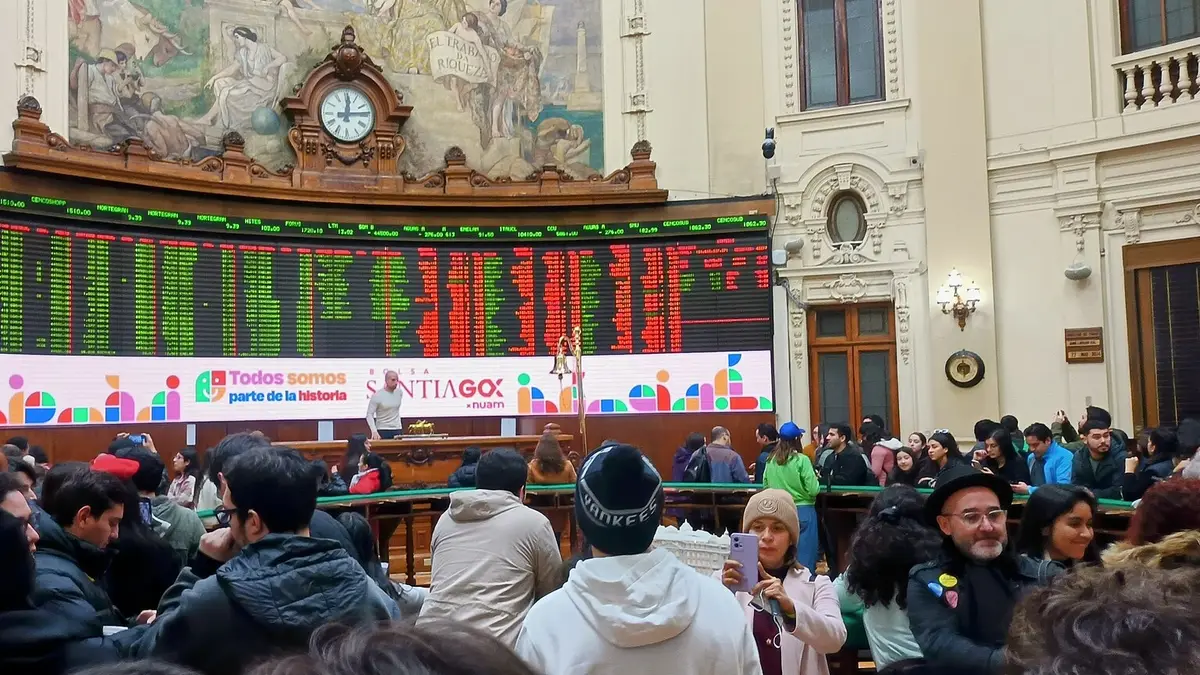
An ETF (exchange-traded fund) is an investment fund that is bought and sold on the stock exchange just like a share, and that usually tracks an index: the S&P 500, the Nasdaq-100, the IPSA or the entire world market. With a single purchase, the investor gets exposure to hundreds or thousands of companies. Its big advantage is cost: the iShares Core S&P 500 (IVV), the largest ETF in this comparison, with US$875,225 million in assets as of November 9, 2026, charges 0.03% a year, according to BlackRock's official fact page. The Chilean equities ETF traded in New York, the iShares MSCI Chile (ECH), charges 0.59% (BlackRock, iShares MSCI Chile ETF).
View the data as a table
| IVV annual cost | 0.03% |
| IVV assets | US$875 billion |
| Companies in ACWI | 2,192 |
| ECH annual cost (Chile) | 0.59% |
What an ETF is and how it differs from a mutual fund
An ETF and a mutual fund are similar at their core: both pool money from many investors to buy a portfolio of assets. The difference lies in how they are bought and how much they cost. Mutual fund units are bought and redeemed directly with the manager at the day's unit value. An ETF is bought and sold on the stock exchange, through a broker, at whatever price it has at that moment, like any share. In addition, most ETFs are passive: they do not try to beat the index but to copy it, which is why their costs tend to be much lower than those of an actively managed fund. How mutual funds work and what they charge in Chile is in our mutual funds guide.
| ETF | Mutual fund | |
|---|---|---|
| Where you buy it | On the exchange, through a broker | With the manager or its agent |
| Price | Changes during the day | One unit value per day |
| Typical strategy | Passive: tracks an index | Active or passive |
| Annual cost | From 0.03% | Varies by series and fund type |
| Entry cost | Broker commission | May have a redemption fee |
Five examples and what they charge
The table brings together five well-known ETFs that track different indexes. The data come from each manager's official fact page, accessed November 10, 2026. The annual cost (expense ratio) is the percentage of assets the fund deducts each year to pay for its management; it is not charged separately but is reflected in the price. These are not recommendations: they help explain what each one buys and how much it costs.
| IVV · iShares Core S&P 500 ETF | S&P 500 | 0.0300% | 875,225 | 505 | 2000 |
| SPY · SPDR S&P 500 ETF Trust | S&P 500 | 0.0945% | 791,877 | 504 | 1993 |
| QQQ · Invesco QQQ Trust | Nasdaq-100 | 0.1800% | No data | 100 | 1999 |
| ACWI · iShares MSCI ACWI ETF | MSCI ACWI | 0.3200% | 32,295 | 2,192 | 2008 |
| ECH · iShares MSCI Chile ETF | MSCI Chile | 0.5900% | 817 | 26 | 2007 |
Two figures from this year help explain diversification: as of November 6, 2026, IVV (S&P 500) was up 8.76% for the year and ACWI (global equities) 8.35%, while ECH (Chilean equities, in dollars) was down 9.66%, according to BlackRock. An ETF concentrated in a single country can move very differently from the world market. What the S&P 500 is and how much it has returned over the long term is explained in our S&P 500 guide.
View the data as a table
| IVV (S&P 500) | +8.76% |
| ACWI (MSCI ACWI) | +8.35% |
| ECH (MSCI Chile) | -9.66% |
Does your brokerage or investment platform want to reach new investors? Advertise on Pauta Financiera.
See advertising optionsHow much the cost weighs over 20 years
A difference of tenths of a percent a year looks small, but it adds up. With CLP 10,000,000 invested for 20 years and an assumed gross return of 7% a year (an assumption for the example, not a forecast), a fund charging 0.03% would end with about CLP 38,480,430; one charging 0.59%, with CLP 34,645,662, and one charging 2%, with CLP 26,532,977. The gap between the cheapest and the most expensive is CLP 11,947,453, from costs alone. It is our own compound interest calculation; how that formula works is in what compound interest is.
View the data as a table
| 0.03% cost | 0.59% cost | 2.00% cost | |
|---|---|---|---|
| Year 0 | CLP 10,000,000 | CLP 10,000,000 | CLP 10,000,000 |
| Year 5 | CLP 14,005,866 | CLP 13,643,073 | CLP 12,762,816 |
| Year 10 | CLP 19,616,429 | CLP 18,613,345 | CLP 16,288,946 |
| Year 15 | CLP 27,474,509 | CLP 25,394,324 | CLP 20,789,282 |
| Year 20 | CLP 38,480,430 | CLP 34,645,662 | CLP 26,532,977 |
How to invest in an ETF from Chile
- Open an account with a broker supervised by the CMF that gives access to international markets, or use your bank's investment platform. The steps to open an account are in how to invest on the Santiago Stock Exchange.
- Decide which currency you invest in. New York ETFs are bought in dollars; you will need to convert pesos, and the exchange rate will affect your result in pesos.
- Check all costs: the ETF's annual cost, the broker's commission on each trade, custody and the currency conversion spread.
- Keep taxes in mind: gains and dividends from foreign investments are declared to the SII in the annual tax return; check the current rules or a tax adviser.
Local ETFs also trade on the Santiago Stock Exchange; the first one to track the IPSA was launched by Banco Itaú, according to Funds Society. For those who want to save in dollars without going through the stock market, how to invest in dollars from Chile reviews deposits and funds in that currency. This information is journalistic and educational, not investment advice; before investing, review each fund's prospectus and costs.
Types and risks
Not all ETFs are the same. Depending on what they track, they fall into five families, each with different risks:
- Broad index ETFs: track hundreds or thousands of companies, such as the S&P 500 or the world market. They are the most diversified and, in general, the cheapest.
- Single-country or regional ETFs: like Chile's ECH. They concentrate risk in one economy and its currency.
- Sector or thematic ETFs: technology, energy, banks or themes such as artificial intelligence. They can rise and fall much more than the market.
- Fixed-income ETFs: invest in government or corporate bonds. They move with interest rates.
- Leveraged or inverse ETFs: aim to multiply or invert an index's daily move. They are designed for very short-term trading and can lose value even if the index ends where it started.
Besides market risk, you need to consider currency risk: a dollar ETF can rise in its own currency and still lose in pesos if the dollar falls, as happened in part this year when the observed dollar dropped from its October peak. There is also tracking error, the small difference between the ETF's return and its index due to costs and taxes, and liquidity risk in small or thinly traded ETFs, where the gap between the buying and selling price can be wider. ETFs carry no state guarantee and their value can fall.
Frequently asked questions about ETFs
What is an ETF in simple terms?
A fund you buy on the exchange like a share that, with a single purchase, gives you a piece of every company in an index.
How much does an ETF charge?
It depends on the fund: among those in this article, from 0.03% a year (IVV) to 0.59% (ECH). The broker's commission and the currency conversion cost come on top.
Can you invest in ETFs from Chile?
Yes, through brokers and investment platforms that give access to international markets, or in local ETFs traded on the Santiago Stock Exchange.
Which ETF tracks the Chilean stock market?
In New York, the iShares MSCI Chile (ECH), with 26 holdings and a 0.59% annual cost, according to BlackRock.