Updated November 6, 2026. The observed dollar published by the Central Bank of Chile stood at CLP 970.95 on Thursday, November 5. It is the official reference, but nobody buys dollars at that price: banks, exchange houses and apps sell with a margin over the market rate, and some add fees. That is why there is no single answer to where to buy dollars in Chile: it depends on whether you need cash for a trip, dollars in an account or a way to pay for purchases abroad.
This guide does not recommend a specific place. It sorts the four channels that exist, explains how to calculate what you are really being charged and gathers, with CMF data, what it costs to use each demand account's debit card outside Chile. To follow the price day by day, see our article on the dollar today in Chile.
View the data as a table
| November 5, 2026 | $970.95 |
| October 2026 average | $982.28 |
| 2026 low | $854.25 |
| 2026 high | $994.29 |
Where to buy dollars in Chile: the four channels
There are four common ways to buy dollars in Chile. Banks sell foreign currency to their customers online, in the app or at branches; exchange houses sell cash; apps and payment platforms let you buy or send dollars from your phone; and credit and debit cards convert pesos when you pay abroad. Each channel sets its own selling price, and no official registry publishes each one's margin.
| Channel | What you get | How the price is set | What to check |
|---|---|---|---|
| Bank (web, app or branch) | Dollars in an account or cash | The bank's own rate, different from the observed rate | Selling price, whether it requires a checking or dollar account |
| Exchange house | Cash | Buy and sell board, changes during the day | Selling price, receipt and counting the bills |
| App or platform | Dollar balance or transfer abroad | Platform rate plus fee, if any | Total cost of the transfer or purchase |
| Card (credit or debit) | Payment abroad or ATM withdrawal | Issuer conversion plus international fee | Fee per purchase and withdrawal abroad |
Source: Pauta Financiera based on information from the CMF and the Central Bank. The practical rule is the same in all four cases: the price that matters is the selling price you are offered, not the observed dollar or the buying price shown next to it on the board.
How to calculate what you pay when buying dollars
The cost of buying dollars is measured as the gap between the price you pay and the day's observed dollar. An example with round figures: buying US$1,000 at the November 5 observed rate would be CLP 970,950. If a seller offers the dollar at CLP 990, you pay CLP 990,000, that is, CLP 19,050 more, 2% over the reference value. If the seller offers CLP 980, the gap falls to CLP 9,050, under 1%.
The Central Bank calculates the observed dollar from the formal exchange market's transactions on the previous business day, which is why it works as a yardstick. In 2026 it moved between a low of CLP 854.25 in February and a high of CLP 994.29 in October: a gap of almost CLP 140 per dollar, much larger than the margin between one seller and another. For a trip, when you buy can matter as much as where.
View the data as a table
| Observed dollar | |
|---|---|
| Jan 25 | $1,001 |
| Feb 25 | $957 |
| Mar 25 | $933 |
| Apr 25 | $962 |
| May 25 | $941 |
| Jun 25 | $938 |
| Jul 25 | $952 |
| Aug 25 | $966 |
| Sep 25 | $960 |
| Oct 25 | $954 |
| Nov 25 | $936 |
| Dec 25 | $916 |
| Jan 26 | $884 |
| Feb 26 | $862 |
| Mar 26 | $910 |
| Apr 26 | $898 |
| May 26 | $898 |
| Jun 26 | $903 |
| Jul 26 | $931 |
| Aug 26 | $918 |
| Sep 26 | $947 |
| Oct 26 | $982 |
| Nov 26 | $982 |
Buying dollars at an exchange house: what to check
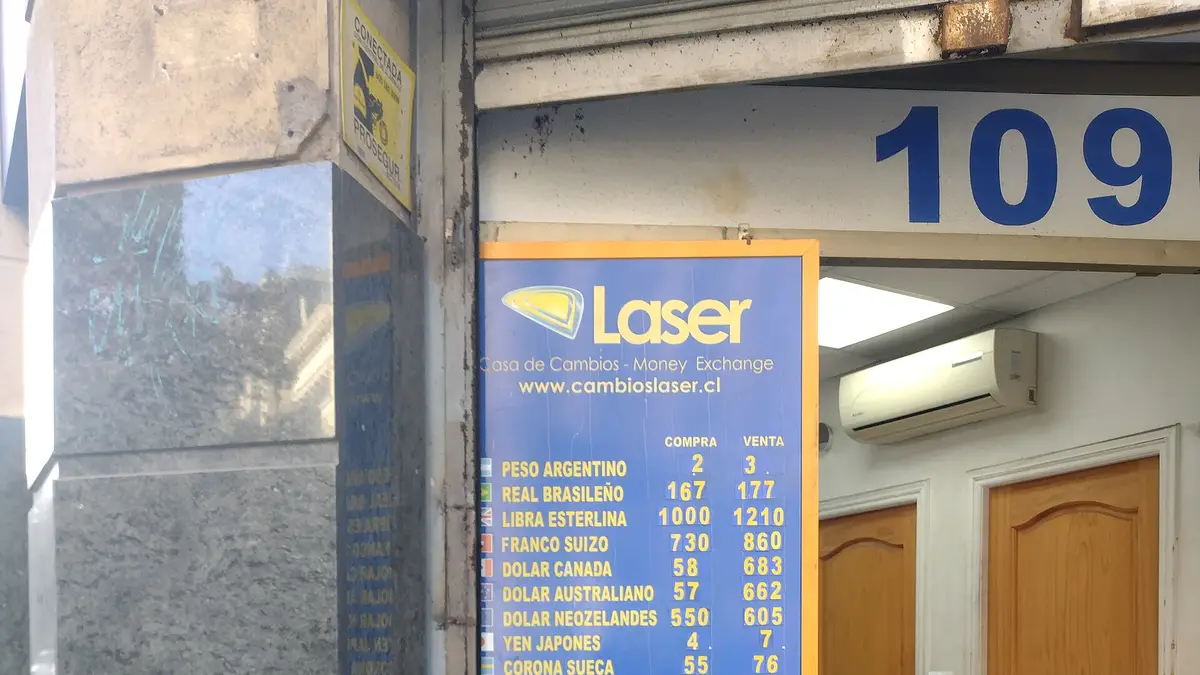
Exchange houses are the most direct way to get cash. They are not banks and are not supervised by the CMF as such: the Central Bank's Compendium of International Exchange Rules distinguishes between the formal exchange market, made up of banks and entities the central bank authorizes, and other exchange transactions. Exchange houses are, however, obligated entities under Law 19,913 on money laundering, which requires them to identify customers and report suspicious transactions to the Financial Analysis Unit.
- Look at the selling column. The board shows two prices: buying (what they pay for your dollars) and selling (what you pay for theirs). When buying, the second one applies.
- Compare with the day's observed rate. The peso difference, multiplied by the dollars you buy, is your real cost.
- Ask for a receipt and count the bills at the counter. Check they have no tears or marks, since some businesses abroad reject damaged bills.
- Avoid street money changers. A transaction without a receipt leaves no record if there are counterfeit bills or a short count.
Buying dollars at the bank, in an app or paying by card
Banks sell dollars to their customers and deposit them in a dollar checking account or hand them over as cash at some branches. The price is the bank's own exchange rate for the day, which each institution shows on its website or app before you confirm. Payment apps and international transfer platforms work the same way: they show their exchange rate and, where applicable, a separate fee. In both cases it pays to compare the total amount in pesos that is debited, not just the unit price.
For travelers, buying cash is often unnecessary: paying by card is enough. There the cost is the international purchase fee each issuer sets. The CMF gathers in its demand account simulator the fees reported by the banks themselves; the table below summarizes what each account's debit card charges for purchases and withdrawals outside Chile. We compare them in detail in our guide to demand accounts by bank.
| Account (bank) | Purchase abroad | Withdrawal abroad |
|---|---|---|
| CuentaRUT (BancoEstado) | 1.9% (minimum US$0.5) | 1.9% (minimum US$0.5) |
| Cuenta FAN (Banco de Chile) | US$0,5 | US$2,5 |
| Cuenta Prima (Bci) | 1.51% | UF 0,1 |
| Más Lucas (Santander) | 3.5% capped at US$2.33 (since Jan 1, 2026) | US$2,33 |
| Individual Demand Account (Scotiabank) | UF 0,0964 | UF 0,0964 |
| Demand Account (Banco Falabella) | $0 | $0 |
| Demand account (Banco Ripley) | $0 | US$2,9 |
| Demand account (Coopeuch) | $0 | $0 |
| Go Bice (BICE) | $0 | US$4,70 |
| Security Cash Familia | 1.92% | US$2,68 |
| Cuenta Más (Consorcio) | US$2 | US$2.5 + 1.9% |
Source: CMF, demand account fee data, fees reported by the banks and in force as of July 31, 2025, the latest update of the file as of November 6, 2026; Santander's charge from January 1, 2026 appears in the same spreadsheet. Some accounts have access requirements (for example, Go Bice is no longer offered to new customers). Among credit cards, Banco de Chile reports a 0% fee on foreign purchases and Santander 2.5%, according to their product pages; details in the best cards to use abroad.
| Cuenta Vista (Banco Falabella) | 0.00 |
| Cuenta vista (Banco Ripley) | 0.00 |
| Cuenta vista (Coopeuch) | 0.00 |
| Go Bice (BICE) | 0.00 |
| Cuenta FAN (Banco de Chile) | 0.50 |
| Cuenta Prima (Bci) | 1.51 |
| CuentaRUT (BancoEstado) | 1.90 |
| Security Cash Familia | 1.92 |
| Cuenta Más (Consorcio) | 2.00 |
| Más Lucas (Santander) | 2.33 |
| Cuenta Vista Individual (Scotiabank) | 4.10 |
How many dollars you can carry on a trip
Buying dollars is unrestricted in Chile, but traveling with them has a rule. According to the National Customs Service, anyone entering or leaving Chile with more than US$10,000 or its equivalent in any currency, including Chilean pesos, in cash or bearer negotiable instruments, must declare it to border control officers. The obligation comes from article 4 of Law 19,913. If a violation is detected, Customs withholds the full amount and must file criminal charges, according to the same page.
| Situation | What the rule says | Source |
|---|---|---|
| Buying dollars in Chile | Unrestricted (art. 39 of the Central Bank Organic Law) | Central Bank |
| Entering or leaving with cash | Declare if over US$10,000 or equivalent | Customs, Law 19,913 |
| Not declaring | Withholding of the full amount and criminal charges | Customs |
| Exchange houses | Identify customers and report suspicious transactions to the UAF | Law 19,913 |
Source: Customs, Law 19,913 and the Central Bank, checked November 6, 2026. Money transfers abroad follow other rules, which each bank reports when processing them.
Does your brand offer currency exchange or international payments? Reach readers who compare costs before deciding.
See advertising optionsWhich channel fits each need
- Cash for a short trip: exchange house or bank branch, comparing the selling price with the day's observed rate. Carry only what you need and pay the rest by card.
- Purchases abroad: a card with a low or zero international fee. Among demand accounts, Banco Falabella and Coopeuch report CLP 0 on purchases and withdrawals; among credit cards, Banco de Chile reports 0% on purchases.
- Saving in dollars: a bank's dollar checking account, which lets you buy and sell without handling cash. The dollar goes up and down: in 2026 it fell to CLP 854 in February and rose to CLP 994 in October.
- Sending money to another country: a bank transfer or remittance platform, comparing the total pesos debited and what the recipient receives.
If you are heading to Europe, the logic is the same with another currency: we explain it in our article on the euro today in Chile. And if you will pay by credit card, check the profile of the Banco de Chile credit card, which charges nothing on foreign purchases.
Frequently asked questions about where to buy dollars
Where is it best to buy dollars in Chile?
No single place is always cheapest. The best approach is to compare each channel's selling price with the day's observed dollar and choose the one with the smallest gap for the amount you need.
What is the observed dollar?
It is the exchange rate the Central Bank calculates from formal market transactions on the previous business day. On November 5, 2026 it was CLP 970.95.
How much cash can I take out of Chile without declaring it?
Up to US$10,000 or its equivalent. Above that amount, Customs requires a declaration when entering or leaving the country.
Is it better to pay by card or carry cash dollars?
It depends on your card's international fee. If it is 0% or low, paying by card avoids the margin on buying cash; if it exceeds 2%, buying cash at a good price may be cheaper.
Are exchange houses regulated?
They are not supervised by the CMF like banks, but they are obligated entities under Law 19,913: they must identify customers and report suspicious transactions to the Financial Analysis Unit.
This information is journalistic and educational, not financial advice. Check the conditions and the total cost (CAE) with the institution before signing up.